Buying a Dishwasher in India: What Actually Matters
Place settings, wash cycles, decibel ratings, hard water — a plain-language guide to choosing a dishwasher that can handle Indian cooking and utensils.
Basgo says12–14 place settings, a hot cycle, a softener. Skip the rest.
A dishwasher was a luxury a decade ago; today it’s the appliance most likely to end a nightly household argument. But dishwasher brochures are written for European kitchens — place settings, decibels, aqua-stop — while your actual question is simpler: will it clean a masala-stained kadhai?
Here’s what each spec means, and what matters for an Indian kitchen.
Place settings — the capacity number that lies to Indians
A “place setting” is one person’s full dinner service by European standards: dinner plate, side plate, bowl, glass, cup, cutlery. Indian cooking produces a different load — more serving bowls, steel tumblers, tiffin boxes, and one large greasy kadhai per meal.
Practical translation:
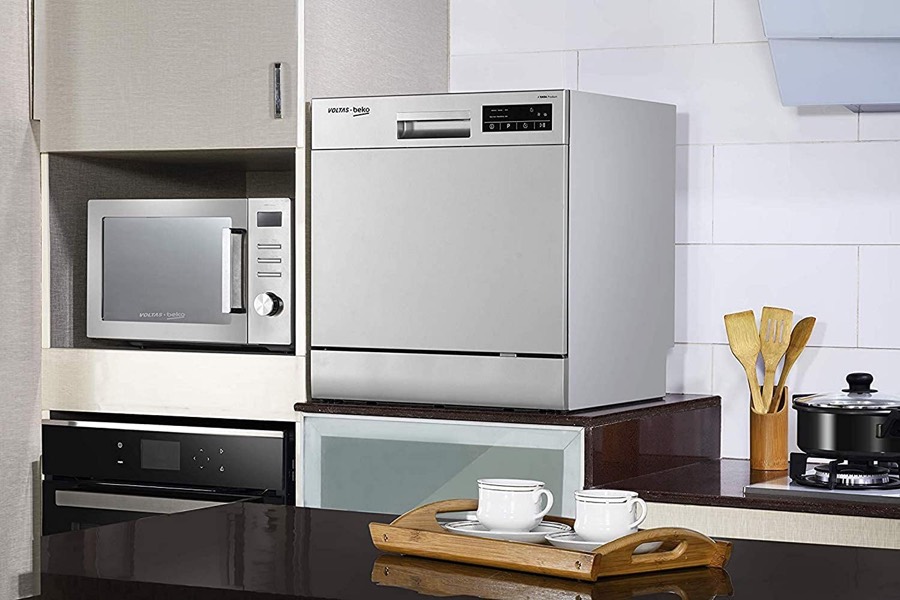
- 8 place settings (countertop models) — couples, light cooking, small kitchens
- 12–14 place settings (free-standing) — the realistic minimum for a family of four cooking Indian meals daily
- 15+ — large or joint families
When in doubt, size up. An under-filled big machine has a half-load mode; an overfilled small machine means washing the overflow by hand, which defeats the purpose.
Cleaning performance — why the heavy cycle is your real spec
Any dishwasher handles lightly soiled plates. Indian cooking tests three harder things: burnt-on food, oily masala residue, and turmeric stains. What handles them is water temperature and cycle intensity — which is why the intensive/heavy cycle (65–70°C) matters more than the brochure’s total cycle count.
Turmeric note, from experience: plastic containers may come out clean but faintly yellow. That’s cosmetic and fades; steel and glass come out spotless.
Drying — the spec everyone discovers too late
Half the job is drying. Machines with stainless steel tubs dry via condensation — moisture leaves the dishes and condenses on the cooler steel walls. Budget models with plastic tubs can’t do this well, so you open the door to clean but wet dishes.
If the price difference stretches to a steel tub, it’s worth it. If not, look for a “heated dry” or “extra dry” option, and crack the door open after the cycle ends.
Noise — what the decibel number feels like
Kitchens increasingly open into living rooms, so this matters:
- Under 45 dB — a quiet library; you’ll forget it’s running
- 45–52 dB — normal conversation level; fine behind a kitchen door
- Above 52 dB — you’ll raise the TV volume
Quieter costs more. Decide based on where the machine will live.
The cycle glossary — decoded in one line each
- Auto / Sensor wash — the machine senses how dirty the water is and adjusts time and heat itself. Use this 80% of the time.
- Intensive / Heavy — hottest, longest, strongest. For kadhais, cookers, and day-old pans.
- Quick / Express (≈1 hr) — lightly soiled loads only; don’t expect miracles on grease.
- Eco / Energy saving — lower temperature, longer duration, cheapest per wash. Great overnight.
- Rinse & hold — a water-only spray to stop smells while you wait for a full load.
- Delicate / Glass — gentler spray and heat for crockery and glassware.
- Half load — washes one rack; saves water when you can’t wait.
- Delay start — run it at 2 a.m. when nobody needs the kitchen (or on cheaper night-tariff power where applicable).
Thirty cycles on the panel is marketing. You will genuinely use four.
Hard water — the India-specific factor brochures skip
Much of India runs on borewell or tanker water that’s hard — loaded with dissolved minerals. Hard water leaves white film on glasses and limescale inside the machine, eventually killing the heater.
Non-negotiables:
- Buy a model with a built-in water softener (most full-size machines have one; check the spec sheet).
- Keep it fed with dishwasher salt — a ₹300 bag lasts months.
- Set the softener to your local water hardness during installation; the installer or manual will show you.
Skip these and no dishwasher will perform, whatever it cost.
Smart features — a one-paragraph verdict
Wi-Fi connectivity lets you start the machine from your phone and get cycle-end notifications. It’s pleasant, not transformative — and one more thing to fail. Never choose a connected 12-place machine over a better-built dumb one at the same price.
The bottom line
For an Indian family kitchen, prioritise in this order: 12–14 place settings → intensive cycle at 65°C+ → built-in water softener → stainless steel tub → under 50 dB. Everything else — cycle count, touch panels, apps — is garnish.
We’re testing specific models hands-on for this category; breakdowns with real photos and video are coming to this page.
Questions people ask
Can dishwashers clean Indian utensils like kadhais and pressure cookers?
Yes — with the right cycle. Masala stains and burnt-on food need an intensive or heavy cycle at high temperature. Steel and aluminium vessels are fine; the main exceptions are non-stick pans with worn coating and delicate hand-painted crockery.
How many place settings do I need for a family of four?
12–14 place settings, even though that sounds oversized. Indian meals use more vessels per dish than the European standard the 'place setting' measure assumes — a family of four cooking twice a day fills a 13-place-setting machine comfortably.
Does hard water affect dishwashers?
Significantly. Most of India has hard water, which leaves white spots on dishes and scale inside the machine. Buy dishwasher salt with every detergent purchase and set the machine's built-in water softener to your local hardness level — the manual shows how.